Saturday, October 29, 2011

Thinner, Sexier, Hotter: 3 Ways to Help Your Daughter Resist Media Pressures


Thinner, Sexier, Hotter: 3 Ways to Help Your Daughter Resist Media Pressures

How do media messages impact your daughter?
How many times have you heard your daughter singing along to a popular song on the radio and innocently belting out the kind of lyrics that would otherwise get her sent to her room? In the moment, you believe (desperately want to believe!) that she is unaware of the innuendo and unaffected by its explicit content. But messages embedded in song lyrics, along with video imagery, and advertisinginfluence do have an impact on the ways girls think about themselves and their relationships with others. Without having to resort to a full-on pop music ban or complete shunning of media, you can help your daughters-and other young girls-become aware of media messages that violate values and degrade girls:

Music Lyrics
The next time your daughter is singing along to a catchy tune with questionable lyrics, use the opportunity to ask her questions like:
• What do you like about his song?
• How do you feel when you listen to it?
• What is it about?
• Have you ever watched the music video for this song?
• Did the video storyline match the words?
• How did the video make you feel when you watched it?
• How were the actors/dancers in the video dressed?

Be sure to convey your genuine interest in her music and opinions rather than coming across as an interrogator. You will be walking a fine line between showing interest in her world and "judging" her taste in music. As long as you can resist the urge to lecture, there can be almost limitless potential for talking about pop music and videos of the day, from lead singers to their fashions, to the messages they are trying to convey, and so on. Let your daughter take the lead.
The goal of this conversation is not to condemn your daughter's taste in music and videos. Rather, asking her to evaluate the lyrics and video images can help her become a more informed consumer and better critical thinker when it comes to awareness of the media influences that surround her on a daily basis.
When young girls get in the habit of asking themselves questions about what they are hearing, seeing, dancing to day after day, and singing out loud, they develop a protective measure of insight and control over ubiquitous media messages-rather than the other way around.
Models of Perfection
The next time you and your daughter are browsing magazines or watching entertainment news on TV, strike up a conversation about how popular advertisements and celebrity photos often bend the truth and trick consumer into seeing things that do not really exist.
Ready for the school year's first vocabulary pop quiz? Ask your daughter to define the term "airbrushing." Explain the concept with the emphasis that some media images use airbrushing to trick girls into believing that "perfection" exists. Explain that when girls take in these messages without questioning them, they can begin to feel badly about themselves, worrying that they don't measure up to impossible standards.
To illustrate, check out the "Dove Evolution" video, available on YouTube or by typing "Dove Campaign for Real Beauty" into an online search engine. This brief clip shows the transformation of an everyday-looking woman into a billboard-ready supermodel. It can be a great discussion tool for showing young girls how it takes an army of professionals to transform one person into "model-readiness." What's more, even with a whole team of hair and make-up artists, the model still needs digital alteration before her image is projected to the world.
"Dove Evolution" is a great visual reminder for kids that seeing should never be believing when it comes to the images in the media. The most important takeaway point of this film and mother-daughter discussion is to encourage your child to feel good about exactly who she is and not to compare herself to media images that are neither real nor attainable (without a team of professionals and digital alteration.)
Clothing and Toys
Children and tweens are the target market for airbrushed images and sexualized products of all kinds, everyday. As way to create awareness in your impressionable youngster, set aside some time with your daughter to browse through store catalogs or walk through toy store aisles. Encourage her to take note of the types of outfits and toys that are available for kids her age. Ask her to share her thoughts on which items represent "real" girls engaged in everyday activities vs. which show girls in age-inappropriate outfits, wearing adult make-up, or doing things you couldn't imagine a girl your child's age doing. Tally the number of items that represent "real" girls versus those that represent unrealistic products for kids her age. How do the numbers compare? What does this tell her?
When your daughter has this interactive experience of seeing how kid-friendly "kid-products" actually are, she gains practice in becoming an engaged, critical thinker. What's more, she takes important steps to being an empowered consumer who can resist the pressures of unrealistic imagery.

Conquering the Beast Within

Jun 17th, 2011 | By  | Category: LeadSocial PsychologyTimothy McGettigan
Are humans basically good, or basically bad? Some people, like Freud, Hobbes, and Foucault, say bad. We’ve got a beast within and the only way to control that beast is to beat it down and repress it. You want proof? Just look at how badly the adults in this world act. They are greedy, selfish, violent, and brutish. But is that the result of human nature, or is it simply the result of toxic socialization? Personally, I think its the latter. Take one giggling, innocent, bubbly, effervescent child, subject them to two decades of disregard and abuse (statistically, rates of child abuse are high), and turn them loose damaged, angry, and desperate! It’s no wonder we live in the world we do. But is it human nature, or should we fault our The System and its agents of socialization? It’s up to you to decide. But be careful, the choice you make determines the society we build.
The beast within?
The beast within?
Long ago, Thomas Hobbes (1588-1679) argued that, in the absence of strict civilizing influences, humans tended to lead lives that were “nasty, brutish, and short.” For Hobbes, human nature was brutal largely because nature is brutal. The law of the jungle is harrowing and, in a state of nature, social niceties generally take a back seat to the grim realities of no-holds-barred struggles for survival.
That humans could flourish in natural environments that were predicated on lethal competition is a complement to the unique array of evolutionary adaptations that comprise modern Homo sapiens. Lacking formidable claws, teeth and body mass, humans have overcome their physiological shortcomings by evolving a matchless intellect. Humans have succeeded in exerting unparalleled dominance over the earth by repeatedly making the point that brawn can always be subjugated by intellect.
For his part, Hobbes was convinced that social control was the key to human progress. No matter how refined any individual may appear, Hobbes was convinced that a primitive beast lurked within. Intellects that have been honed in the pitiless crucible of survival competitions remain indelibly a product of those struggles. Yet, though Hobbes believed that a savage resided within every human heart, he also believed that it was possible to tame those internal beasts. This could be accomplished via the application of social control. In a well-regulated environment where ne’er-do-wells are disciplined swiftly and certainly, Hobbes asserted that individuals can be effectively dissuaded from pursuing purely self-interested, and thus, anti-social activities. The key to civilizing the human animal is to ensure that individuals remain more fearful of disobeying the instruments of centralized authority (i.e., Big Brother) than they are tantalized by the potential benefits of pursuing brazen self-interest. Under such circumstances, “civilized behavior” results from a straightforward cost-benefit calculation: if defying authority bears greater costs than the perceived benefits of seeking self gain, then individuals will elect to pursue loftier, more socially-productive goals.
Though it’s an unflattering view of human nature, nevertheless, Hobbes’ principles still remain the foundational insights upon which many modern criminal justice systems operate. Humans can accomplish great things, but only if we imprison our baser human natures–whether we reside in penitentiaries or not–in rigidly enforced systems of social correction.
Indeed, this was also Michel Foucault’s key insight in Discipline and Punish (1975). Foucault argued that, as societies have become increasingly complex, forms of social control have also evolved to new levels of sophistication. For example, as fast as information technologies evolve, surveillance technologies that are designed to monitor the thoughts and movements of global netizens proliferate. Though IT users understandably chafe under the often onerous intrusiveness of evolving surveillance technologies–and the policies that authorize their use (e.g., USA Patriot Act)–failure to maintain aggressive data-monitoring initiatives invites 9/11-style abuses. Thus, humans being what they are, the more that IT enhances our intellectual capabilities, the more necessary it will be to impose increasingly draconian forms of electronic surveillance.
But that’s not a very pleasant thought, is it? Who the heck wants to believe that Big Brother will (or, worse yet, ought to) inevitably win in the end? Not me. No way.
Still, for every new use that we discover for information technologies, it seems as if digital scallywags invent at least one, if not a thousand, more abuses. Which of the visionary inventors of the Internet imagined that cyberspace would open up boundless opportunities to hawk pornography, sidestep gambling restrictions, pilfer electronic identities, manage shadow banking systems, or coordinate global terror networks?
Self-regulation has a tendency to be ineffectual simply because, as Hobbes argued, it is folly to rely upon the better angels of human nature. Left to itself, human nature tends to be dominated more by demons than angels. For example, Alan Greenspan, the former Chair of the Federal Reserve, subscribed to the fanciful conviction that deregulation would inspire a market-based solution to financial fraud. Instead, as one might expect, Greenspan’s philosophy of unchecked deregulation only amplified the scope of financial abuse (a la Bernie Madoff and OTC derivatives) during his term as Fed Chair. The 2008 financial meltdown was largely a consequence of Greenspan’s pollyannaish faith in the magic of deregulation.
Civility is a product of social control, whereas crooks flourish in an environment of deregulation. Further, it is naive to insist otherwise–unless we’re intent upon aiding and abetting crooks. That said, creativity is inspired by unfettered individual inquiry. From Galileo to Julian Assange, the best ideas often transgress the most sacred social boundaries. This is a point that I have made repeatedly in other discussions.* Truth is an outcome of conflict and dissent rather than consensus.
Can we have it both ways? In other words, can information technology be both an instrument of repression as well as a vehicle with which to creatively contravene established rules and regulations? Like it or not, it is both already and must remain so. If we are going to outmaneuver mischief in the rapidly evolving landscape of the information society, then we will need to employ a big, strong, technically-savvy Big Brother to put the kibosh on fast-adapting cyber-deviants. However, the more adept that Big Brother becomes, the greater the chances that he’ll become an overzealous bully.
Family relationships are never ideal. We may need a Big Brother, but we don’t have to like him. In fact, if we are going to derive any real benefits from this sibling relationship, then it will have to remain a rivalry. We can empower Big Brother to be a protector, but only if, simultaneously, we apply ourselves unremittingly to dissuading Big Brother from being a bully. In practice, this means trying to put one over on Big Brother every chance we get. Big Brother may not agree, but hackers and crackers are his best friends. It might sound counterintuitive, but there is no better way to keep Big Brother alert and in line–and also to inspire the individual intellectual bravado that will ensure an enlightened and progressive civilization–than an incessant and ferocious sibling rivalry.
*See Utopia on Wheels (1999) and Good Science (2011).

How consumerism has enslaved us

By  

It used to be identity was to be found in the way we thought, the groups we were a part of, and the things we held dear. More and more, however, we exist in a monotonic world where our identity is provided by the things we display (cloths, watches, smart phones, stinky chemical scents), our thinking is remarkably conformist and identical, and we all belong to the same social group knowm as “the consumers.” It is a brave new world world where the pain of our shrinking sense of self can, we are told, be easily be mitigated and managed with the appropriate product purchase (booze, antidepressents, social phones) . But in case you haven’t realized, more product purchase doesn’t help. The anxiety and malaise continue to grow.
Slave to fashion
Just take a stroll to the nearest mall (or the nearest upcoming one) on a weekend and what do you see? Hordes of shoppers pushing their way through a gigantic stampede of other shoppers lulled by the power of the brand name and the “discount” price tag. Count yourself lucky if you can complete that shopping trip unmauled by the forces of “nature”. Shades of a pilgrimage to the Holy Land of Mecca flash before one’s eyes as one struggles to meander the unnavigable terrain of merciless consumers hunting for yet another generic Osim chair or “that new outfit by Forever 21 that I simply must have”.
Brand name consciousness, certainly, is the mantra by which we eat and breathe these days. From designer bottled water to purified mountain air, Nokia, OSIM, Nike, GAP, Levi’s, and its likes make up the Ten Commandments of the materialistic sub-culture we inhabit. One is easily compelled to wonder why of all things does one need to brave the throng yet another Sunday in the “largest shopping mall in (insert continent)” to purchase yet another little black dress and phone accessory to match when others can scant tell the difference whether its really Pucci or Grada or what the Ah Beng in Petaling Street said was ‘in’ this monsoon.
Nevertheless it is an untiring business as thousands of Ah Lians with boyfriends and butt-crack revealing jeans (and boyfriends in their butt-crack revealing jeans) join forces every other weekend to ensure the struggle does not fade from light. From ‘romantic’ strolls in bookstores while snogging each other and glaring at any poor soul who happens to read in their way, to snatching the last fur-coated cropped cardigan from any poor soul who happens to be paying for it in their way, the quest for more material goods continues. And again next week. Like what Arnie in good ol’California would say, “I’ll be back.”
Indeed, yours truly, a former avid shopper and holder of the longest shopping marathon award has now been relegated to a shadow of her former self. One is not ashamed to say that one is now terrified of malls due to the fear of the impending mindlessness and lack of consideration of others from the first step into the shopping sphere. A twilight zone of apathy mixed with feigned blindness engulfs as one takes that hesitant step. It is as though one is cloaked by the hands of evil – the evil of money, surely – as everyone else pretends to see no mercy, hear no mercy, and of course, speak no mercy as they bump you nonchalantly out of the queue you’ve been standing in since an hour ago. (Just try GSC Mid Valley on a school holiday).
You want to say you’re sorry for not letting them jump queue – you poor little kind soul – rare as you are like a gem in the rough. But they give you the eye and you shrink back – only to bump into the bouncer from Hell who is so dedicated to his night job, he lives it out during the day. So you scurry into the only refuge you think still exists – only to see that the toilet is now a war zone – or at least Daniel Craig must have had his first victim up as James Bond in there. And you’re at a total loss.
Don’t blame yourself, folks. Welcome to the realm of mass consumerism and the rebirth of Fordism, camouflaged in brand names. You can have any colour you want, the ads say, as long as its branded. Look at Paris Hilton’s twinkling lips. Of course its just an Ah Lian with blond hair and Japanese contacts in blue taking a puff. But the colour stays, like what they say at Maybelline. Or Revlon. Or any other brand of lip gloss, really. The product doesn’t really matter, it’s the tagline, dah-ling.
The extent of which corporations will go to in order to sell their products can be no less baffling. A number of these unashamedly breach the reins of political correctness, going all out to produce sexist ads. Sex, for them sells, and apparently, sexist-ness does too. Just watch TV for a night. You’ll see that nine (and I may be wrongly optimistic) out of ten ads featuring household products have women starring as doting housewives, inane smiles plastered all over their more-than-willing to play Stepford wife faces as they scrub yet another kitchen tile while the ‘man’ goes out to battle it out in the corporate warrior’s battlefield. When he (in all his glory) returns, he is treated to a spot-free house and dinner, with his wife all the while smiling that inane smile.
Or you get ads featuring some blossoming young girl, books in hand and all, apparently on her way to some educational institution. On the way she meets love. Love, as it is, is a boy riding a bike who crashes into a wall, mesmerized by our heroine’s beauty. Next scene we see her happily scrubbing child-stained walls, still mesmerized husband coming home from work. And its all thanks to some brand of paint. Need love? Desperate to become a housewife? Want a goofy husband who’ll promise you that dream job of wall-scrubbing? Discover paint. Period.
Some ads try to appear a little more “politically correct”. The woman, now, is some corporate warrior herself. She battles it all day at work. Then she comes home to see Mr. Househusband not doing too well in the domestic sphere. She loses temper. After all, which warrior doesn’t scream a battle cry or two occasionally? Husband makes her coffee. Its named after some sort of lighthouse. She wavers. She is drawn to the carrot. Now the man is back, wielding power in his hands. A woman, as it is, has to be tamed. Otherwise she is nothing but a screaming shrew. And the screaming shrew says, “Never mind, darling, you sit down and relax. I’ll do all the work.”
Of course, the most unpretentious ones tell the truth. Or the constructed ‘reality’ as they so often name that new brand of voyeuristic TV shows like The Simple Life. Some girl tries out a new brand of beauty products. Its named after some fabric that resembles satin. By implication the metaphor describes girl as ‘soft’. Of course. Then there’s an old man of a photographer, 90 or so. He is asleep on a chair. Initially sensibly dressed girl is now a sprightly beauty (one that many CCTV cameras would automatically wake up to, if a particular Minister gives the go) and her enthusiasm wakes the sleeping old man up. Old man is stimulated, girl is ecstatic, and they dance the dance of Eros, our old photographer all the while snapping away. Humbert Humbert would feel so betrayed.
It seems true, at times, the joke about TV shows “being those annoying breaks between endless runs of TV commercials”. What with Petronas ads and all. But sadly enough these too often fall into the trap of parochialism and bad taste. But see one, and you see ‘em all. After all, its all about the brands, not the contents, my dear.

How Occupy has shifted the national debate


How Occupy has shifted the national debate


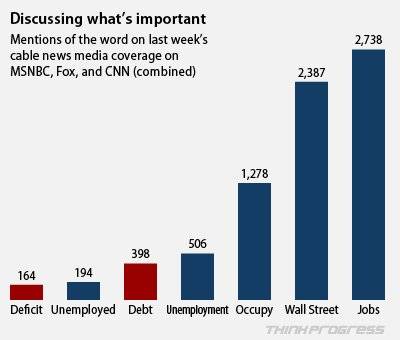
Prior to Occupy Wall Street, the dominant narrative in US politics was about debt and deficit reduction, and the attendant austerity measures that entailed. A study of keywords from network newscasts shows that the national policy discussion has shifted in the wake of the Occupy demonstrations, with an increased emphasis on unemployment and fairness (this shift is also visible in print media).
The debt/deficit discussion was fueled by organizations like Peterson’s Fiscal Times, funded by hyper-rich individuals to promote an economic ideology grounded in cuts to social programs.

Wednesday, October 5, 2011

Steve Jobs

http://www.latimes.com/business/la-fi-steve-jobs-obit-20111006,0,7210103.story

Steve Jobs died today :-(
Most of the industrial world has been touch by him or his products. He will be missed and we may never see another visionary like this again. He has changed the way we listen to music, communicate with others interact with media.